

The best automation solution is not always the most advanced one. It is the one that best fits your process, production goals, and operational realities.
When a production line is under pressure, automation may be the obvious answer. Few things match automation when it comes to simultaneously addressing output increases, labor reductions, safety concerns, rework issues, and consistency challenges. The question isn’t whether or not to automate, but how.
Should we buy off-the-shelf equipment, or do we need a custom automation solution?
The answer depends on the problem you are trying to solve. Off-the-shelf equipment can be the right choice when the process is standardized, the product is simple, and the production need closely matches equipment already available in the market. Custom automation becomes the better choice when the part, process, tolerance, safety requirement, inspection need, or production environment does not fit a standard solution.
The fundamental risk is choosing an automation path too quickly. A standard machine that cannot handle your real-world process can create more downtime, workarounds, and frustration than it solves. A custom system built before the problem is clearly defined can also become overcomplicated or misaligned with the business case.
The goal is not to automate for the sake of automation. The goal is to build a manufacturing process that is safer, more repeatable, more productive, and better suited to the work your team actually needs to do.
Start with the manufacturing problem, not the equipment
 Many automation projects begin with a product search. A team sees a bottleneck and starts looking for machines, robots, feeders, presses, conveyors, inspection systems, or assembly equipment. That can be useful, but it can also lead the project in the wrong direction.
Before comparing standard equipment and custom automation, manufacturers should define the problem in operational terms:
- What process is slowing production down?
- What quality issue keeps showing up?
- What task is difficult to staff, train, or repeat?
- What manual step creates safety or ergonomic risk?
- What inspection requirement is being missed or delayed?
- What changeover or setup process consumes too much time?
- What customer requirement is becoming harder to meet?
Those questions matter because the best automation path may not be a fully automated cell. It may be a custom fixture, a semi-automatic station, a robotic loading system, an integrated inspection process, a servo-controlled press, a better part presentation method, or a redesigned workflow.
Ahaus often sees this in complex manufacturing environments. The customer may know the production pain but not the exact solution. That is normal. A good automation partner should help translate the pain into a workable concept, then into a machine, fixture, cell, or system that can survive production reality.
When off-the-shelf equipment makes sense
Off-the-shelf equipment can be a smart investment when your process closely matches a known, repeatable application.
- Standard equipment is often a good fit when:
- The part geometry is simple or common.
- The process is already well understood.
- Tolerances are not unusually tight.
- The equipment does not need major integration with other systems.
- Production volume justifies the purchase.
- Operators can load, unload, and maintain the machine without complex support.
- The equipment can meet your cycle time without extensive modification.
- Your facility has the floor space, utilities, and support structure the machine requires.
- The process does not require unusual guarding, fixturing, data collection, or inspection.
For example, a manufacturer may be able to use standard equipment for basic conveying, common packaging operations, simple pick-and-place tasks, routine marking, or repetitive assembly steps where the parts and process are predictable.
The main advantage is speed. Standard equipment may be available faster, require less engineering time, and have known performance characteristics. It may also be easier to quote, easier to justify internally, and easier to compare across vendors.
Even then, off-the-shelf equipment still has to work within the realities of your production environment. A standard machine may perform the core operation, but it may still need the right tooling, part presentation, guarding, controls integration, operator access, inspection process, or runoff criteria to perform reliably on your line. In many cases, an automation partner can help confirm whether the standard equipment is the right fit and identify what needs to happen around the machine for the full process to succeed.
Off-the-shelf equipment only works well when the assumptions behind the machine match the reality of your line. If your parts vary, your process has special requirements, your tolerances are tight, or your operators are already creating workarounds to make the current process function, a standard machine may only automate the symptoms. It may not solve the root problem.
When custom automation is the better investment
Custom automation becomes valuable when the manufacturing challenge is too specific, too complex, or too important for a standard solution.
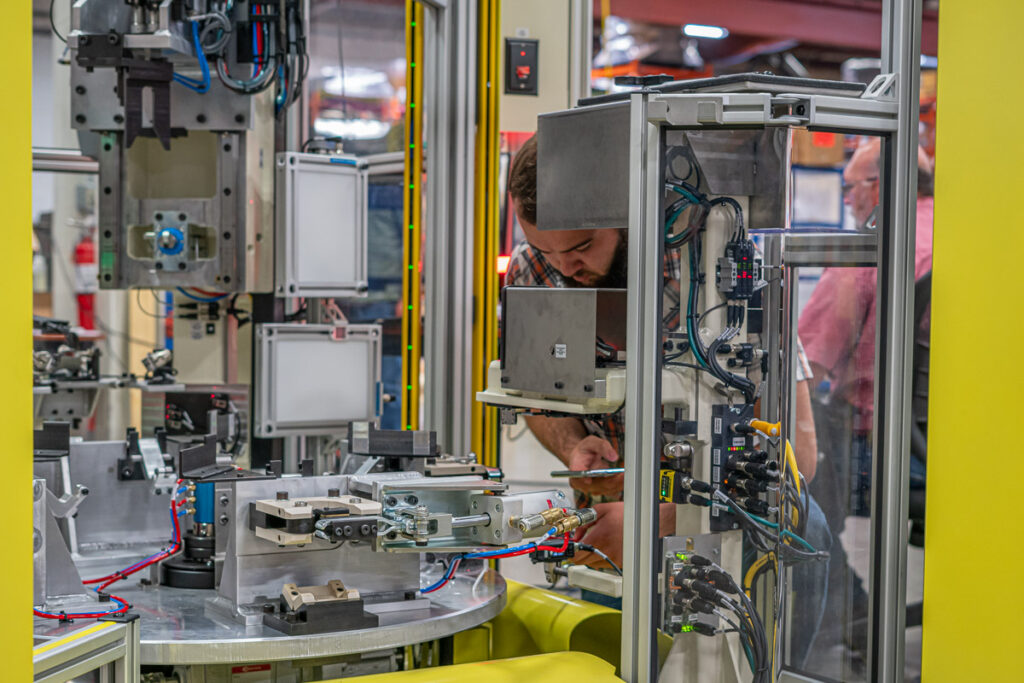
A custom system may be the better path when:
- The part has unusual geometry, size, weight, or material characteristics.
- The process requires precise positioning, pressing, joining, loading, or assembly.
- The machine must integrate with existing equipment, controls, fixtures, or inspection systems.
- Quality depends on repeatable force, orientation, timing, or sequence.
- Operators are exposed to ergonomic, pinch-point, lifting, or repetitive-motion risk.
- The line requires traceability, data collection, or process validation.
- Changeovers must be faster or more repeatable.
- The process involves multiple stations or steps.
- A standard machine would require major modifications.
- The cost of scrap, downtime, or quality escapes is high.
Custom automation is not simply “a machine built from scratch.” At its best, custom automation is a manufacturing solution designed around the specific part, process, operator, facility, and business goal.
That may include mechanical design, controls engineering, robotics, custom workholding, part handling, machine vision, inspection, guarding, machining, fabrication, programming, testing, and installation support. The strength of a custom approach is that these pieces can be designed as one system rather than forced together after the fact.
This is especially important when the process touches critical quality characteristics. If a part must be located a certain way, pressed to a certain force, inspected before the next operation, marked for traceability, or handled without damage, the automation design has to account for those requirements from the beginning.
The hidden risk of choosing the wrong automation path
The wrong automation choice rarely fails all at once.
More often, it creates a slow leak in the operation.
A standard machine may technically work, but only when the most experienced operator is running it. A fixture may hold the part, but not consistently enough to reduce variation. A robot may move the part, but the upstream presentation is unreliable. A press may complete the operation, but the process data is not captured. A vision system may inspect the part, but lighting, orientation, or surface variation creates false rejects.
These issues can lead to:
- More downtime than expected
- Slower cycle times than promised
- Operator frustration
- Manual workarounds
- Extra inspection
- Scrap and rework
- Missed delivery commitments
- Maintenance issues
- Low confidence in future automation projects
This is why the decision should not be based only on equipment cost. A lower upfront price can become expensive if the system does not fit the process. A custom solution may require more planning and engineering, but it can create a better long-term return when the manufacturing problem requires a purpose-built answer.
A practical decision framework
Manufacturers can use the following framework to evaluate whether off-the-shelf equipment, modified standard equipment, semi-automation, or custom automation is the right fit.
- Part complexity
If the part is simple, consistent, and easy to orient, standard equipment may be enough.
If the part is heavy, flexible, delicate, oddly shaped, cast, machined, or difficult to locate, custom workholding or custom automation may be needed.
Ask:
- Is the part easy to present consistently?
- Does part variation affect the process?
- Can the part be damaged during handling?
- Does the part require special support or clamping?
- Is orientation critical?
- Process complexity
A simple, single-step process may fit standard equipment. A multi-step process with sequencing, joining, inspection, pressing, marking, or data capture may require a custom approach.
Ask:
- How many operations are involved?
- Does the process require controlled force, motion, timing, or temperature?
- Does the system need to verify each step before moving forward?
- Are there failure modes that need to be detected automatically?
- Quality requirements
The tighter the quality requirement, the more important it is to design the process around repeatability.
Ask:
- What tolerances must be held?
- What defects are most costly?
- Is inspection manual, automatic, or both?
- Does the process require documentation or traceability?
- Can the system prevent defects instead of only detecting them?
- Volume and product mix
High-volume, low-variety production often supports dedicated automation. High-mix production may require flexible tooling, modular fixtures, quick-change features, or semi-automatic systems.
Ask:
- Is the product stable or changing?
- How often do changeovers happen?
- Will future part variants need to run on the same system?
- Is flexibility more important than maximum speed?
- Operator involvement
Automation should improve the work, not simply move the difficulty somewhere else.
Ask:
- What does the operator do today?
- Which steps are repetitive, risky, or hard to train?
- Where do operators use judgment or workarounds?
- What information does the operator need from the machine?
- How should the system support safe loading, unloading, maintenance, and troubleshooting?
- Integration needs
A machine that performs well by itself may still fail if it does not integrate with the larger process.
Ask:
- Does the equipment need to connect with existing machines?
- Are there plant standards for controls, safety, or data?
- Does the system need to communicate with inspection, marking, or production systems?
- Are there floor space, guarding, utility, or maintenance constraints?
- Business case
The right solution should connect directly to the financial and operational outcome.
Ask:
- What is the cost of the current problem?
- What improvement would justify the investment?
- Is the goal labor utilization, throughput, quality, safety, capacity, or all of the above?
- What happens if the problem is not solved?
- What risks are created by a partial solution?
Off-the-shelf, modified standard, or custom: which path fits?
Most projects fall into one of four categories.
| Option | Best when | Watch out for |
| Off-the-shelf equipment | The process is common, stable, and low-risk. | It may not fit real-world part variation, quality requirements, or integration needs. |
| Modified standard equipment | A standard platform can perform the core function but needs custom tooling, guarding, programming, part handling, or controls. | Scope can creep if the base machine is not a true fit for the process. |
| Semi-automatic station | Operators should stay involved, but repeatability, safety, ergonomics, or quality needs to improve. | The responsibilities of the operator and machine must be clearly defined. |
| Fully custom automation | The process is complex, quality-critical, difficult to staff, or central to production capacity. | It requires stronger upfront problem definition, engineering, testing, and validation. |
The role of workholding in automation decisions
One of the most overlooked parts of automation is how the part is held.
A robot, press, inspection system, or machine tool can only be as consistent as the way the part is located and supported. If the workholding is weak, even advanced automation can produce inconsistent results.
Workholding matters because it affects:
- Part location
- Repeatability
- Clamp force
- Deflection
- Operator loading
- Cycle time
- Inspection accuracy
- Machining access
- Changeover speed
- Safety
In many cases, the automation conversation should begin with the fixture. If the part cannot be presented, located, clamped, or supported consistently, the rest of the system will struggle.
This is where custom workholding and custom automation often overlap. The best system may require both: a fixture designed for the part and an automation process designed around that fixture.
Do not automate a bad process without improving it first
Automation can make a good process faster and more repeatable.
It can also make a bad process fail faster.
Before investing in equipment, manufacturers should look closely at the current process. Which steps are truly necessary? Which workarounds have become normal? Where does variation enter the process? Where does the operator compensate for poor part presentation, weak fixturing, missing inspection, or unclear sequence?
A strong automation partner will not simply ask, “What machine do you want?”
They should ask:
- What are you trying to improve?
- What is happening today?
- What have you already tried?
- Where does the current process break down?
- What does success need to look like?
- What constraints do we need to design around?
Those questions protect the investment. They help ensure the final solution addresses the root cause instead of automating around it.
Why manufacturers involve Ahaus early in the automation decision
The right automation decision often depends on more than the machine itself. It depends on how the part is held, how the operator interacts with the system, how quality is verified, how the process is controlled, and how the solution performs once it reaches production.
Ahaus supports manufacturers by bringing together engineering, custom automation, workholding, machining, controls, inspection, and manufacturing capabilities. That combination is important because automation projects rarely succeed through isolated pieces. A robot may need custom end-of-arm tooling. A press may need controlled force and process data. A fixture may need to support repeatable loading and inspection. A machine may need to fit into an existing line, controls architecture, safety standard, or maintenance environment.
When manufacturers involve Ahaus early, the conversation can begin with the production challenge instead of a predetermined equipment choice. That allows the team to evaluate whether the right answer is off-the-shelf equipment, modified standard equipment, a semi-automatic station, custom workholding, a robotic cell, or a fully custom automation system.
A simple plan for choosing the right automation path
If your team is deciding between off-the-shelf equipment and custom automation, start with a clear plan.
Step 1: Define the constraint
Identify the specific bottleneck, risk, or quality issue. Do not stop at “we need automation.” Define what needs to improve and why it matters.
Examples:
- Reduce manual handling of heavy parts
- Increase assembly throughput
- Improve press force consistency
- Reduce scrap from poor part location
- Integrate inspection into the production process
- Improve changeover repeatability
- Reduce operator exposure to repetitive or hazardous tasks
Step 2: Match the solution to the process
Evaluate whether standard equipment can solve the problem as-is. If not, determine whether modified equipment, semi-automation, custom workholding, or a fully custom automation system is the better fit.
The right solution should be no more complex than necessary and no less capable than required.
Step 3: Validate before production
A successful project should include design review, build, runoff, testing, and support. The system should be evaluated against real production requirements before it becomes a critical part of the line.
Validation should answer:
- Does the system meet cycle time?
- Does it hold the part consistently?
- Does it meet quality requirements?
- Can operators use it safely and effectively?
- Does it integrate with the surrounding process?
- Can maintenance support it?
- Does it produce the expected business outcome?
Need help deciding between standard equipment and custom automation?
If your line is under pressure and you are not sure whether off-the-shelf equipment, custom workholding, semi-automation, or a fully custom automation system is the right move, Ahaus can help you define the problem and evaluate the best path forward.
FAQ: Custom automation vs. off-the-shelf equipment
Is custom automation always more expensive than off-the-shelf equipment?
Custom automation often has a higher upfront engineering and build cost, but upfront price is only one part of the investment. If a standard machine requires constant workarounds, causes downtime, creates quality issues, or cannot meet production needs, it may cost more over time. The better comparison is total cost of ownership and production impact.
When should a manufacturer avoid custom automation?
A manufacturer should avoid custom automation when the process is not well understood, the production need is temporary, the part design is likely to change dramatically, or a proven standard machine can solve the problem with minimal risk. Custom automation works best when the production problem is important, repeatable, and worth solving properly.
Can off-the-shelf equipment be customized?
Yes. Many projects use a hybrid approach. A standard platform may be paired with custom tooling, fixtures, guarding, part handling, controls, inspection, or integration. This can be a practical option when the core machine is suitable but the application requires production-specific engineering.
How do I know if my process is ready for automation?
A process is ready for automation when the team can clearly define the desired outcome, current failure modes, part requirements, quality expectations, cycle time goals, safety needs, and business case. If those inputs are unclear, the first step may be an engineering review rather than an equipment purchase.
What is the biggest mistake manufacturers make when choosing automation?
The biggest mistake is starting with a machine instead of starting with the problem. Automation should be designed around the production constraint, part requirements, operator needs, and business outcome. When those factors are skipped, even good equipment can become the wrong solution.
Should I involve an automation partner if I am buying off-the-shelf equipment?
Yes, especially if the equipment needs to integrate with an existing line, handle specific parts, meet strict quality requirements, improve operator safety, or connect with other machines and controls. Off-the-shelf equipment may solve the core operation, but an automation partner can help make sure the full process works in production.


Ready to Build?
Contact a Sales Engineer.